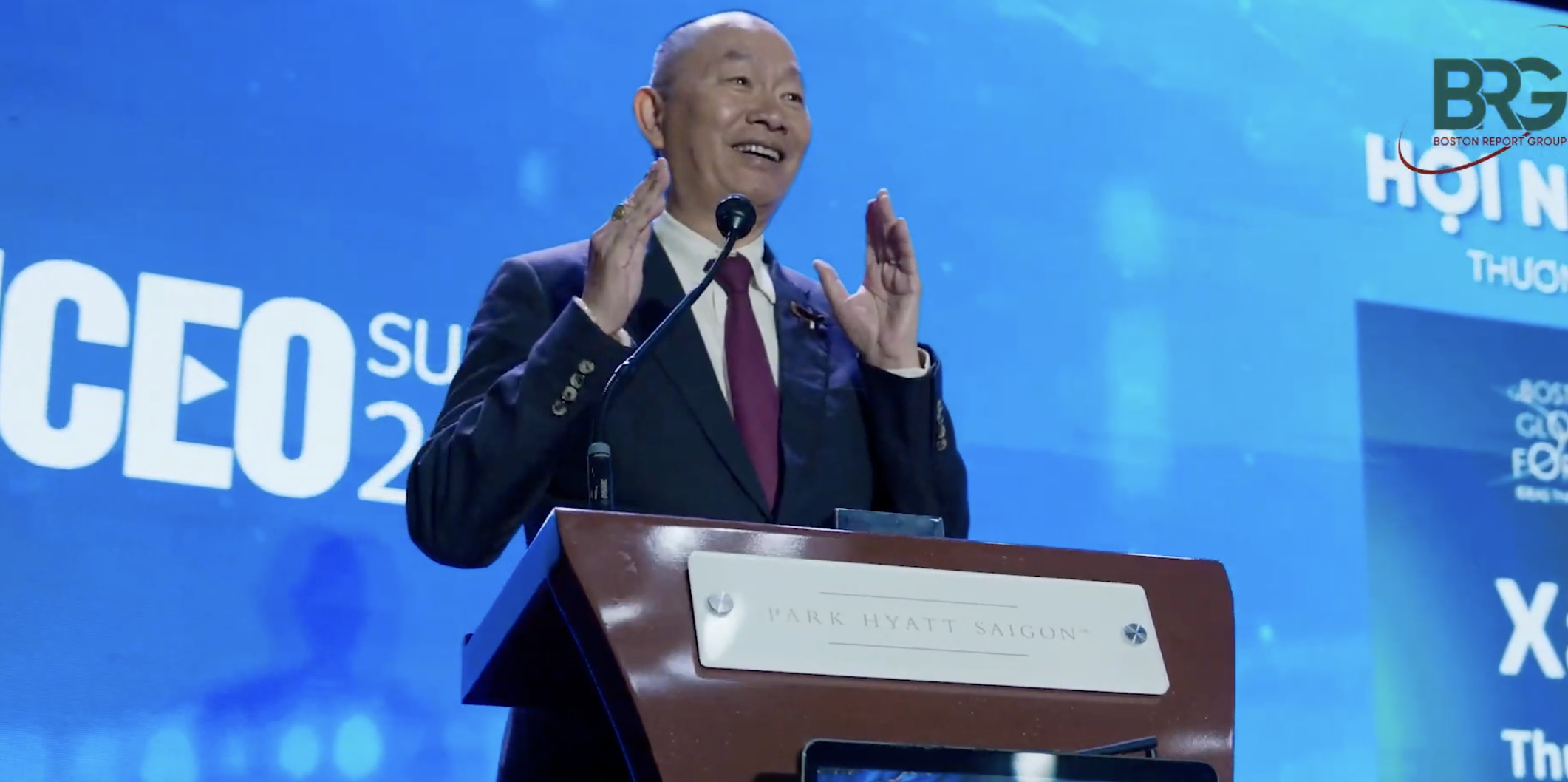
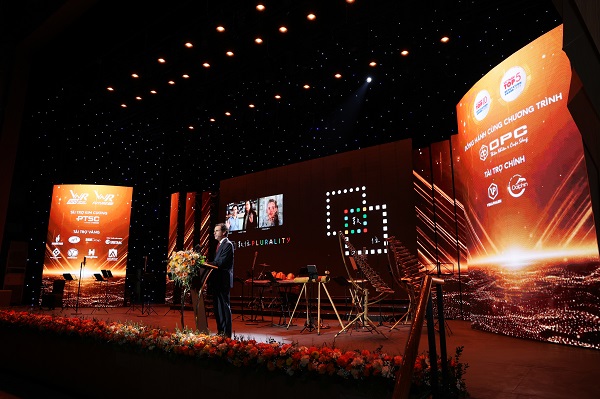
As global governance enters a period of deep turbulence, a keynote speech by Dr. Glen Weyl carried a clear message: the crisis of technology and the crisis of governance are not separate problems. They are increasingly intertwined and, if designed wisely, can become solutions to one another. Speaking at the VNR500 2025 ceremony (Top 500 Largest Enterprises in Vietnam), organized by Vietnam Report in collaboration with VietNamNet, Dr. Weyl, an economist and founder of the RadicalxChange Foundation, argued that Vietnam may be approaching a rare historical moment. In his view, the country has an opportunity to leap forward not only economically, but also in how it thinks about governance for the AI era.
A Global Governance Order in Flux
Dr. Weyl opened with a broad diagnosis of today’s world. The international governance order, he said, is rapidly transforming and may be in its most fluid, and possibly most unstable, state in decades. Global institutions such as the United Nations and the World Trade Organization, along with governance mechanisms for domains like space, the Arctic, and artificial intelligence, face systemic strain.
This governance crisis, he argued, is arriving at the exact moment when technological change is accelerating faster than ever, placing unprecedented demands on social institutions. Artificial intelligence is poised to reshape labor markets at a scale not seen since industrialization. It is also generating new social risks, including psychological dependence and emotionally entangled human–AI relationships, with serious mental, ethical, and societal consequences.
Plurality: When Technology and Governance Become Mutual Solutions
From this reality, Dr. Weyl introduced the core concept of Plurality, a book he co-developed with Audrey Tang and international collaborators. A Vietnamese edition is expected soon. Its central claim is deliberately counterintuitive: the governance crisis and the technology crisis are not two separate equations. They can solve each other.
According to Dr. Weyl, advances in digital technology, especially AI and blockchain, make it possible to build governance systems that go beyond industrial-era frameworks, including models associated with Western liberal democracy. At the same time, new governance architectures, if designed correctly, can help societies steer and harness technology for the common good, rather than allowing technology to reshape society by default.
To illustrate that network-based governance is not exclusive to the digital age, he pointed to a historical example: the 13th-century process for electing the Doge of Venice. In that system, citizens elected committees, the committees elected other committees, and the process ultimately selected the ruler. The structure, he suggested, resembles what we now call a neural network. The lesson is that sophisticated network logic can organize society, and society’s structure can, in turn, govern its technologies.
From Social Platforms to Public Decision-Making: AI’s Emerging Role
A notable part of Dr. Weyl’s remarks focused on practical examples of how AI can support social consensus. He referenced “Community Notes” on X (formerly Twitter). In this model, AI does not impose a single top-down truth. Instead, it clusters viewpoints across different perspectives and surfaces notes that gain support across conflicting groups, attaching them to posts as contextual information.
He argued that this approach is increasingly influencing governance experiments. He cited Japan as an example where AI is being used to interact with citizens, synthesize opinions, build consensus, and support long-term vision-setting that does not depend solely on rigid party structures.
He also stressed a design principle: AI should not be built as a “god,” a friend, or an emotional substitute for human connection. Rather, AI should represent the voices of communities, including nations, professions, and social groups. The goal is to strengthen social cohesion instead of eroding it.

Digital Economy, Data, and “Data Dignity”
Connecting directly to Vietnam’s leading enterprises, Dr. Weyl highlighted the concept of “data dignity.” AI cannot develop without human-generated data. Therefore, he argued, rather than viewing AI only as a threat to jobs, societies should treat citizens’ data contributions as a new form of economic and creative input, worthy of recognition and fair value distribution.
He also discussed models of digital assets and voluntary self-assessment of property value. He suggested these could provide pathways toward forms of common ownership in a post-industrial society, an idea he linked to thinkers such as Karl Marx, Sun Yat-sen, and Ho Chi Minh. In this framing, markets are not eliminated. They are redesigned to serve the common good while improving resource allocation efficiency.
Vietnam’s Opportunity to Leap Forward
Dr. Weyl described Vietnam as having an unusually strong opportunity. He noted Vietnam’s position among the world’s fastest-growing economies and argued that the country is not as tightly bound to Western governance models that, in his view, are showing signs of decline.
As Vietnam reaches middle-income status and confronts new global trade barriers, he suggested this may be the perfect moment to demonstrate strategic independence and shape a distinctive development path. He linked this capacity to Vietnam’s historical resilience, from the era of the Trưng Sisters to the Ho Chi Minh era, when Vietnam repeatedly confronted and overcame major powers of its time.
In his conclusion, Dr. Weyl proposed that Vietnam could become a model for a new governance approach. He framed this as a path that avoids two extremes: centralized authoritarianism on one side, and the limitations of traditional parliamentary systems on the other. In place of both, he argued for leveraging AI and digital technologies to organize society, strengthen cooperation, and advance development for the common good.
In the formal setting of the VNR500 2025 ceremony, his speech functioned not only as an academic reflection, but also as a strategic prompt for Vietnam’s business community and policymakers. At a time when the world is searching for new development models, his message was clear: with a dynamic economic foundation and a growing innovation ambition, Vietnam has the potential to be among the pioneers shaping the future of governance in the AI age.